Latest additions
Project Palmetto and the airport compatibility zones
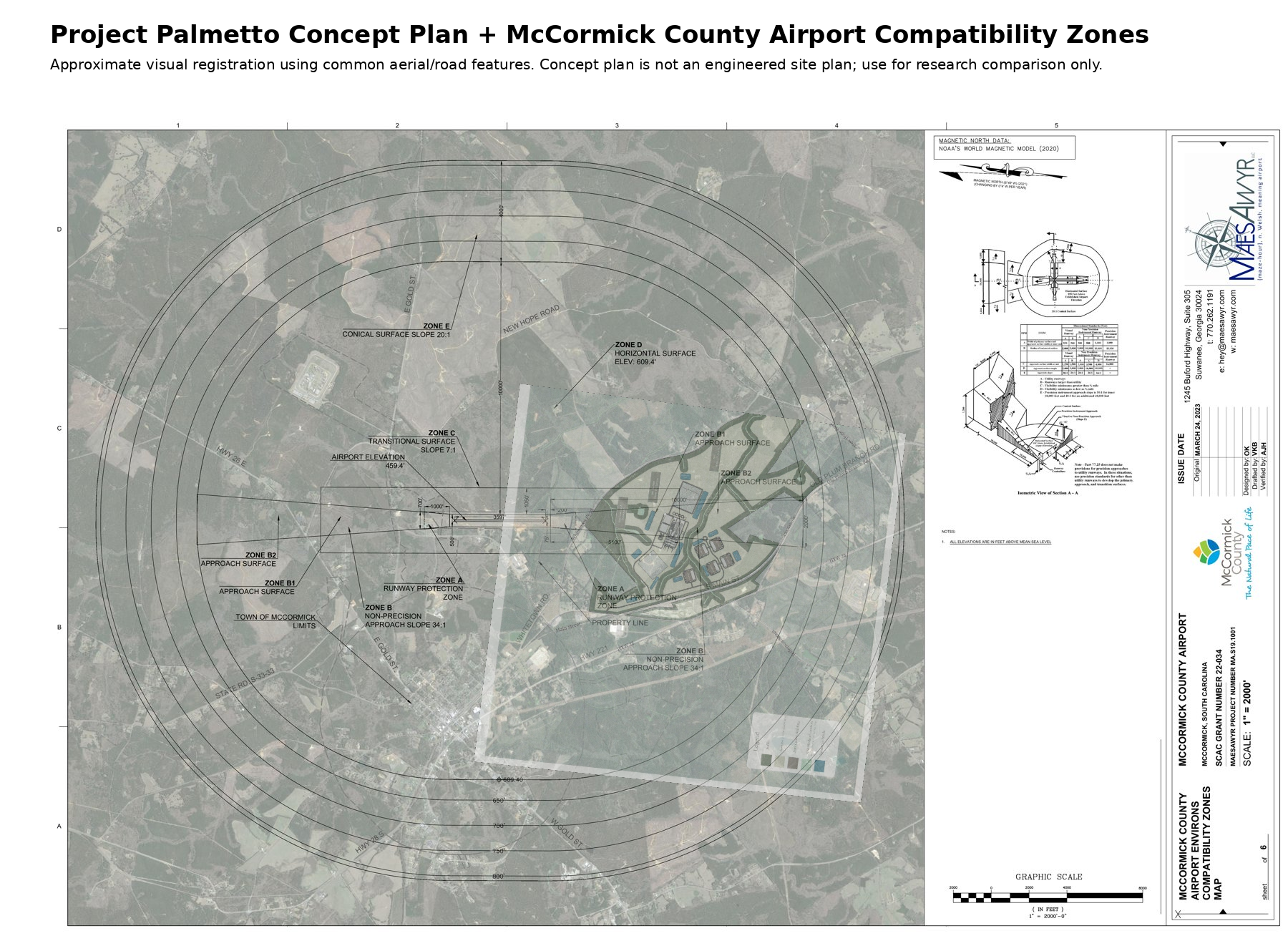
This graphic places the Project Palmetto concept plan over the McCormick County Airport compatibility-zones map using approximate alignment of common aerial and road features.
Research comparison only: This is not an official zoning map, survey, engineered site plan, or determination of compliance. Apparent overlaps do not establish exact parcel or building locations, applicable restrictions, or whether a proposed use is permitted. Those questions require the official mapping and project-specific review.
Download approximate overlay (PNG) →
Read the Airport Overlay District ordinance and source documents →
Balanced planning frameworks
These resources are included as neutral planning anchors. They focus on the questions communities and decision-makers should consider rather than presuming that data center development should either proceed or be stopped.
Key Considerations for Data Center Development
A national bipartisan policy report developed following roundtables and interviews with more than 150 participants representing data center developers, utilities, regulators, government officials, financial institutions, environmental and conservation organizations, agricultural interests, consumer advocates, community members and data center opposition groups.
The report examines five areas communities and decision-makers should consider: transparency and communication; power and water; quality of life; land use and environmental impacts; and economic development.
Rather than advocating simply for or against data center development, it focuses on questions communities, developers and policymakers can address to support informed decision-making and responsible development.
Why McCormick First included it: The framework provides useful questions for evaluating potential development and identifying issues that could be addressed during a temporary moratorium or local planning process. It also shows that questions about water, electricity, transparency, land use, economic benefits, noise and enforceable protections are mainstream planning considerations.
Research documents
The presentation recording and handout are provided for public information. The handout is applicant-provided material and is not an official McCormick County document or an independently verified McCormick First analysis. Other research materials are educational resources. The rural-community discussion reference is identified as a working draft and presents commonly raised concerns alongside credible counterpoints—not a recommendation for or against a data center.
Data Center Initiative
Understanding County Roles
Planning Commission vs. County Council
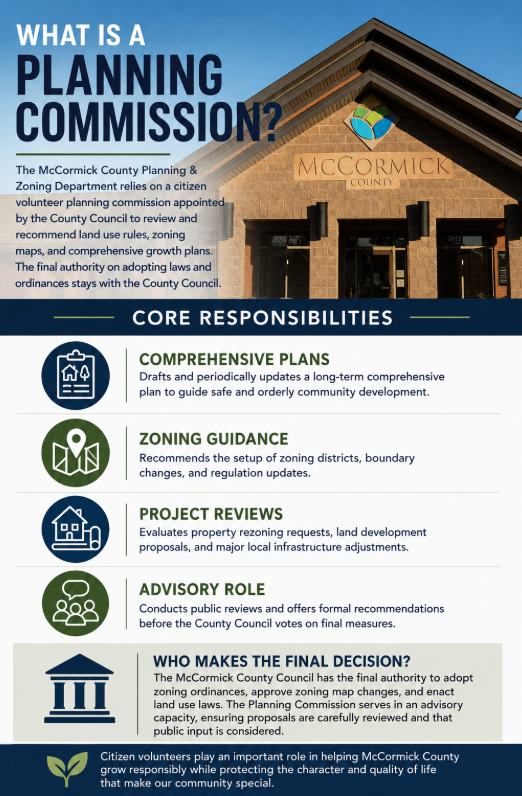
McCormick County's Planning Commission is an advisory body made up of citizen volunteers appointed by County Council. It reviews land-use and zoning matters and makes recommendations. County Council retains final authority to adopt zoning ordinances, approve zoning-map changes and enact land-use laws.
This distinction is important when researching potential data center development. Planning & Zoning may be the appropriate source for questions about zoning requirements and procedures, but it may not possess information concerning economic-development negotiations, project financing, utilities, incentives or technical plans associated with a prospective development.
The County's graphic states that the Planning Commission evaluates property rezoning requests, land-development proposals and major local infrastructure adjustments. That land-use role should be distinguished from the separate economic-development or vendor proposal, negotiations and commitments that may involve County Council, County administration, economic-development staff, utilities or other agencies.
Source: McCormick County — originally published via the County's Nextdoor account.
 Open the County graphic at full size →
Related current records
Official agendas and government records remain housed in the Public Documents section. Meeting summaries are McCormick First informational materials and are identified separately from official records.
Topics we are following
Water & Wastewater
Capacity, cooling, upgrades, fire protection, and cost allocation.
Power & Natural Gas
Generation, pipelines, grid connections, emissions, and noise.
Planning & Zoning
Permitted uses, setbacks, buffers, enforcement, and approvals.
Taxes & Incentives
FILOT agreements, revenue credits, projections, and public costs.
Jobs & Economic Impact
On-site and remote work, local hiring, wages, and tax base.
Public Safety & Environment
Emergency response, stormwater, air permits, and traffic.